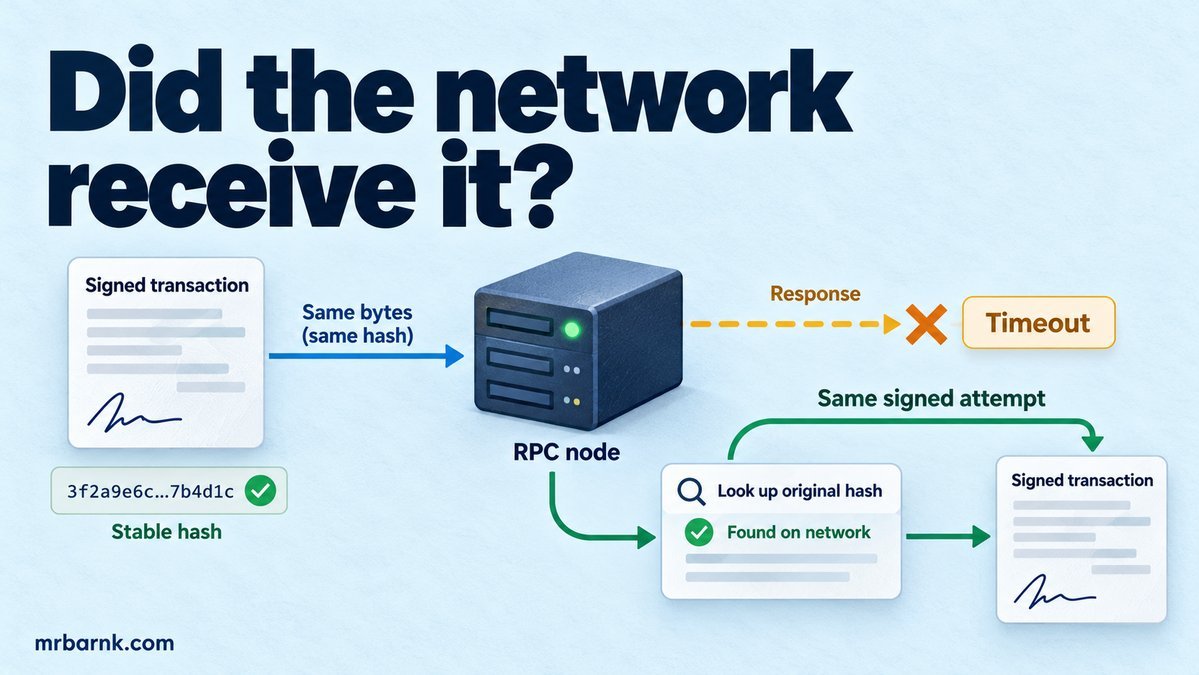
An Ethereum transaction broadcast timeout doesn’t tell you whether the network received the transaction. Your RPC provider may have accepted the signed bytes and lost the response. If you immediately build another transfer, the customer could end up with two business operations.
Let’s preserve the exact attempt before sending it. Then a timeout becomes a question we can investigate, instead of a reason to invent another transaction.
Record the business operation and signed attempt
Create a stable operation ID for the intended transfer or contract action. Store its chain, sender, recipient, value, calldata and approval evidence under the appropriate policy.
After signing, persist the exact bytes and transaction hash before broadcasting. Use a vetted Ethereum library to derive the real hash and encode transactions; don’t substitute a generic SHA-256 hash or hand-written encoding.
The local example uses sample payloads and hashes. They are not valid signed transactions. The code never sends them to a network.
Treat broadcast as submission evidence
A successful RPC response generally gives you a transaction identity, not final execution success. You still need inclusion, receipt status and your chain-specific confirmation policy.
Ethereum documents the transaction lifecycle separately from submission. Keep those stages separate in your application as well. Transaction lifecycle reference.
If the request times out, mark the attempt’s submission result uncertain. Keep its original identity available for lookup and, where appropriate, rebroadcast of those same bytes.
Build the lost-response case
The simulated provider accepts the original payload, then throws before returning a response. The recovery path submits the same recorded payload and confirms that it still represents one transaction identity.
import assert from 'node:assert/strict';
const operation={id:'transfer-1',attempt:{hash:'fixture-hash-1',bytes:'fixture-signed-payload',state:'prepared'}};
const network=new Map();
let loseResponse=true;
async function broadcast(attempt){
  network.set(attempt.hash,attempt.bytes);
  if(loseResponse){loseResponse=false;throw new Error('Response lost');}
  return attempt.hash;
}
try{await broadcast(operation.attempt);}catch{operation.attempt.state='unknown';}
assert.equal(operation.attempt.state,'unknown');
assert.equal(network.has(operation.attempt.hash),true);
const recovered=await broadcast(operation.attempt);
assert.equal(recovered,'fixture-hash-1');
assert.equal(network.size,1);
assert.equal(operation.id,'transfer-1');
console.log('PASS: ambiguous broadcast recovery preserves exact attempt identity');
This is a local model of a lost response. It does not sign Ethereum transactions or copy every response a real node can return. The test checks that recovery keeps the first attempt instead of creating a second transfer.
Reconcile more than one signal
Query the original transaction hash and receipt through your configured providers. Compare chain identity and relevant head information. A missing result from one endpoint may mean propagation delay, a provider issue or a transaction that is no longer retained there.
Check account nonce and your own attempt history before deciding to replace anything. If the nonce has been consumed, identify which transaction used it and what its receipt says.
Don’t interpret “not found” as an instruction to allocate a new nonce immediately. That decision needs the operation’s reconciliation policy, especially if a replacement or external wallet action exists.
Rebroadcast and replacement are different
Rebroadcasting the same valid signed bytes preserves the transaction hash. A node may report that it already knows the transaction or reject it for another documented reason. Classify those responses rather than treating every error as proof of failed execution.
A replacement creates a different signed attempt using the same sender and nonce. It belongs under the same business operation when it is a permitted replacement. Keep both hashes and the rule that authorised the change.
Creating another transfer with a new nonce is a separate action. Only do that once your application has established why it is safe. A generic HTTP retry helper should not make that choice.
Track inclusion and execution separately
An included transaction can revert. Record the receipt status and relevant contract outcomes before marking the business action successful.
For token transfers, inspect the expected contract and state changes rather than assuming a familiar-looking event means the supported asset moved as intended. Keep integer amounts and chain-qualified asset identities.
Then apply the finality policy appropriate to the network and business operation. A provider returning a receipt once doesn’t make that block permanently canonical.
Design storage for investigation
Use an operation table and an attempt table. The attempt records nonce, hash, bytes, submission timestamps, provider responses, receipt observations and replacement links.
Protect sensitive transaction information and signing material. A signed transaction may be broadcastable, so store and expose it deliberately rather than putting it in every support log.
Give operators a way to inspect an unresolved operation without clicking a button that creates a new transfer. Recovery should use recorded evidence and a clear permission boundary.
Test the uncertain windows
Crash before broadcast, after the provider accepts bytes and before the local success update. Restart and confirm that recovery uses the recorded attempt.
Also test a provider that never accepted the transaction, one that reports it already known and a transaction later included with a reverted receipt. Those cases need different explanations even if the original client saw a timeout in all of them.
Start by persisting the signed attempt before sending. That gives your recovery code a stable object to inspect, and prevents an ambiguous network response from silently turning into a duplicate business action.
Run the example and adapt it
Save the code as 28-ambiguous-transaction-broadcast.mjs and run it with Node.js 24 or later:
node 28-ambiguous-transaction-broadcast.mjs
The code above includes assertions you can run locally. It tests the local decision logic with controlled inputs; it doesn’t connect to a live provider or establish production performance. Keep that boundary when adapting it to your application.